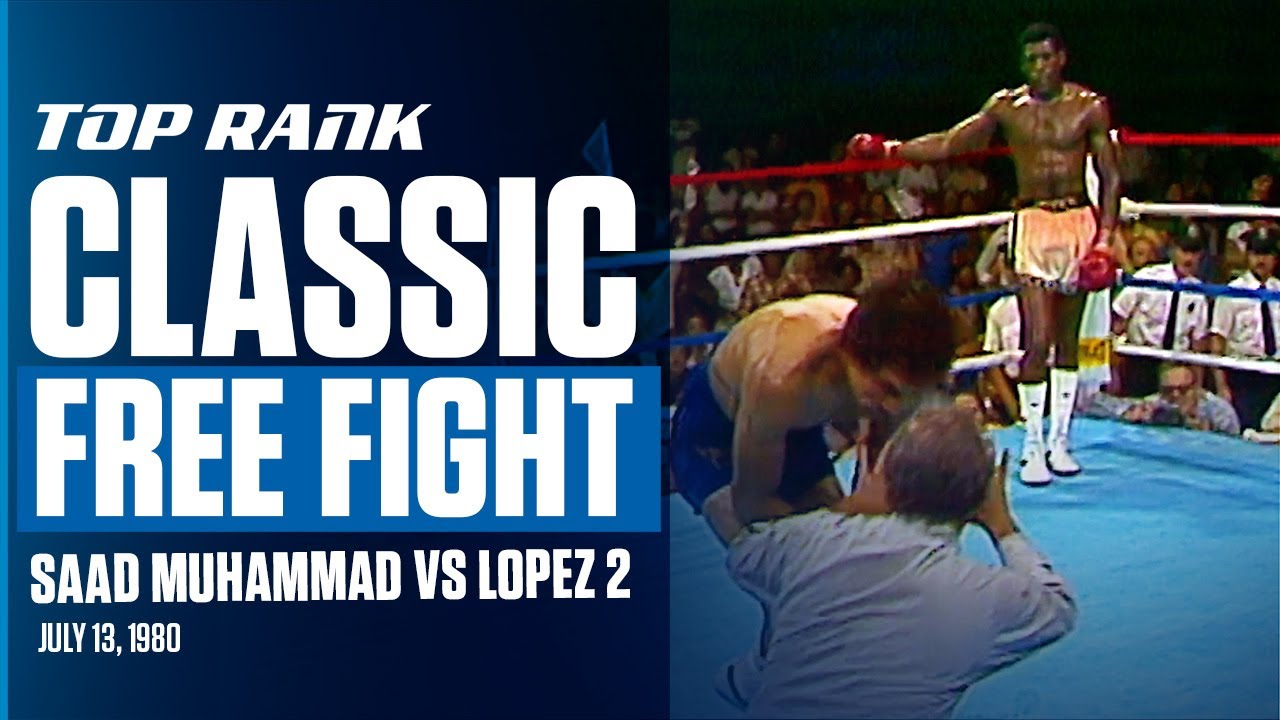
Matthew Saad Muhammad vs Yaqui Lopez II

Fight Details
- Date: 13th July 1980
- Venue: Great Gorge Playboy Club, McAfee, New Jersey
- Title: WBC World Light Heavyweight Title
- Promoter: Top Rank
- Referee: Waldemar Schmidt
- TV: CBS Sports Saturday
Fighters
Matthew Saad Muhammad
Record: 26-3-2
Weight: 174¼ lbs
Yaqui Lopez
Record: 49-9-0
Weight: 173¾ lbs
Fight Summary
Matthew Saad Muhammad retained the World Boxing Council light-heavyweight championship at the Great Gorge Playboy Club in McAfee, New Jersey, on July 13, 1980, stopping Álvaro “Yaqui” López after four knockdowns in the fourteenth round. The end came at 2 minutes 3 seconds, when referee Waldemar Schmidt intervened without completing a count after López had fallen to his knees for the fourth time. Both men weighed 174 pounds for the scheduled 15-round contest, which was televised nationally by CBS. It was Muhammad’s fourth defence of the title and the second meeting between two fighters whose first contest, in Philadelphia in October 1978, had ended with López being stopped in the closing second of the eleventh round.
Muhammad had since won the world championship from Marvin Johnson, changed his name from Matthew Franklin after converting to Islam, and successfully defended the belt against John Conteh twice and Louis Pergaud. He had also kept a promise made after the first López fight, when he told the challenger that he would grant him another opportunity should he become champion. López entered this second contest with considerable experience in a championship company. He had twice gone 15 rounds with Victor Galíndez for the World Boxing Association title and had lost close decisions on both occasions. His previous defeat by Muhammad had been severe, but it had not discouraged him from seeking another contest with the Philadelphia champion.
López began the rematch with greater discipline than he had shown in their first meeting. Taller and longer in the arm, he moved laterally, worked behind a firm left jab and tried to prevent Muhammad from settling at punching distance. Muhammad advanced steadily but was made to follow rather than cut off the ring. López mixed the jab with straight right hands and hooks to the body, and by the second round, he was already forcing the champion backwards and making him cover up. He varied his attack intelligently, sometimes moving after scoring and at other times remaining close enough to exchange. Muhammad landed solid blows of his own in the third, fourth and fifth rounds, but López’s greater activity and changing angles gave him the better of much of the early work. The challenger’s punches also began to mark the champion’s face.
The pace increased in the sixth. López caught Muhammad with a heavy uppercut and followed with hooks to the body, leaving the champion breathing through an open mouth. Muhammad, as was often his practice, accepted punishment while continuing to press forward. He did not attempt to escape by sustained movement but remained close, looking for the left hook and overhand right that had rescued him in earlier fights. In the seventh, he landed a rising left hook to López’s jaw, but the challenger took it without retreating and continued to box with confidence. At the end of seven rounds, López had established the advantage. His jab had been effective, his combinations had been quicker, and Muhammad had not yet been able to impose the kind of attritional contest he preferred.
The eighth round became the central passage of the fight. Muhammad started it strongly, driving López towards the ropes and landing enough punches to worsen cuts around the challenger’s eyes. For the first time, López appeared momentarily flat-footed and vulnerable to the champion’s pressure. Midway through the round, however, López suddenly reversed the position. He drove Muhammad back and launched a long, uninterrupted attack of hooks, uppercuts and straight rights. Muhammad stood near the ropes with his gloves raised but was struck repeatedly around the head and body. Approximately 40 punches were thrown during the sustained assault, with a considerable number landing cleanly. For a time, the champion offered almost nothing in reply. Referee Schmidt watched closely, but Muhammad remained upright, continued to defend himself and gave no indication that he wished to be rescued.
López eventually slowed after expending himself in the attack. Muhammad, instead of collapsing or holding, immediately began punching back. His recovery was as sudden as López’s assault had been. The challenger still landed before the bell and almost certainly won the round, but he returned to his corner having failed to stop a man upon whom he had used much of his remaining strength. Muhammad had taken the heaviest punishment of the contest and survived it. More importantly, López no longer moved with the same ease when the ninth began.
From that point, the character of the contest altered. Muhammad resumed his advance, but now López was less able to keep him at the end of the jab. The champion forced exchanges at shorter range and worked heavily to the body before bringing his punches upstairs. López continued to answer and occasionally produced sharp combinations, but his attacks came in shorter bursts and were followed by longer periods in which Muhammad drove him backwards. The champion won the ninth and tenth rounds through pressure and heavier punching. López remained competitive, yet the quickness and variety of his early work were disappearing.
Muhammad maintained the same method through the eleventh and twelfth rounds. He gave López little room, absorbed the challenger’s remaining counters and returned with harder blows. López could still jab and hook when given space, and at times he stood his ground rather than concede it, but each exchange took more from him. The twelfth was fought largely at close quarters, with both men landing on the head and body. López’s face was bloodied, and his movements had become laboured. Muhammad was also badly marked, but his strength and forward momentum were increasing rather than declining.
The thirteenth belonged clearly to the champion. López tried to revive his earlier boxing, but his legs no longer carried him out of range after he punched. Muhammad followed him across the ring, landed a strong right hand and continued with hooks as López attempted to answer. The challenger was not yet helpless, and he produced one determined attack that pushed Muhammad towards the ropes, but it was brief. By the bell, López was tired, cut and under steady pressure. Muhammad had now won every round from the ninth onward on the official cards.
Muhammad began the fourteenth knowing that López’s resistance had weakened. A heavy right hand to the head caused the first knockdown. López rose and attempted to meet the champion’s attack, but Muhammad followed with another combination and put him down again. There was no three-knockdown rule in effect, and the contest continued after López regained his feet. Muhammad did not rush wildly. He stepped forward behind straight punches, used the left hook when López tried to move away and forced him into another exchange. A third knockdown followed, but López again rose.
The challenger’s courage remained, although his strength and balance had gone. Muhammad closed in once more and landed the final right hand cleanly. López dropped to his knees with blood running from his nose. Schmidt stopped the contest immediately, without beginning another count. The official time was 2 minutes 3 seconds of the fourteenth round.
All three officials had Muhammad ahead when the fight ended, although the scores showed how much of the early contest López had controlled. Judge Frank Brunette scored it 125–122, Judge Paul Cavalier 125–123, and referee Schmidt 124–123. Muhammad had therefore taken command narrowly but decisively through his uninterrupted run of winning rounds from the ninth onward.
The contest was later selected as The Ring magazine’s Fight of the Year for 1980, while the eighth was named Round of the Year. Those distinctions rested not merely upon the volume of punching but upon the extraordinary change that followed López’s attack in the eighth. The challenger had produced his strongest work and appeared close to victory, yet Muhammad’s survival exhausted him physically and altered the direction of the fight. Muhammad emerged badly marked but still champion, having again demonstrated the durability and finishing power that distinguished his title reign. López suffered another defeat in a world championship contest, but his performance, particularly during the first eight rounds, confirmed that he was capable of competing on equal terms with the leading light-heavyweights of his period.

Gym Rat Assessment
For me, Matthew Saad Muhammad vs Yaqui Lopez II is one of the greatest light-heavyweight fights ever. I was a big Saad fan because you were never getting a quiet night with him. He had already stopped Lopez in their 1978 NABF title fight, then beaten Marvin Johnson for the WBC crown and built a reputation for dragging himself back from places where most fighters would have folded. Lopez had twice pushed Victor Galindez over 15 rounds, so this was no manufactured challenger. He was a proper world-class contender who had earned another chance.
Lopez boxed beautifully early on. He used his longer reach, worked the jab and caught Saad with clean combinations as the champion came forward. Then came that eighth round. Lopez trapped him and unloaded punch after punch, landing around 20 unanswered shots at one stage. Any sensible trainer would have been halfway through the ropes. I would never teach a fighter to absorb punishment like that because sooner or later, the bill arrives. But Saad was different. He stood there, survived it, and fired back before the bell. That was the moment Lopez must have wondered what more he could possibly do.
From the ninth onwards, Saad took over. Lopez had emptied his tank trying to finish him, while Saad kept marching forward, working the body and forcing harder exchanges. By the fourteenth, Lopez was exhausted, and Muhammad dropped him four times before the referee stopped it at 2:03. Saad was ahead on all three cards.
That was Saad Muhammad in a nutshell. Far too easy to hit, frighteningly tough and never beaten until the final bell or the referee said otherwise. They called him “Miracle Matthew,” but there was no miracle about it. The man simply possessed a will that very few fighters have ever matched.
Matthew Saad Muhammad vs Yaqui Lopez II on YouTube
FAQ
Who won the Matthew Saad Muhammad vs Yaqui Lopez fight?
Matthew Saad Muhammad won by 14th round tko.
When did Matthew Saad Muhammad vs Yaqui Lopez take place?
Matthew Saad Muhammad vs Yaqui Lopez took place on 13th July 1980.
Where did the Matthew Saad Muhammad vs Yaqui Lopez fight take place?
It took place at Great Gorge Playboy Club, McAfee, New Jersey.
What titles were at stake in the Matthew Saad Muhammad vs Yaqui Lopez fight?
Matthew Saad Muhammad and Yaqui Lopez fought for the WBC World Light Heavyweight Title.
Comments (0)
Please log in to leave a comment
Loading comments...